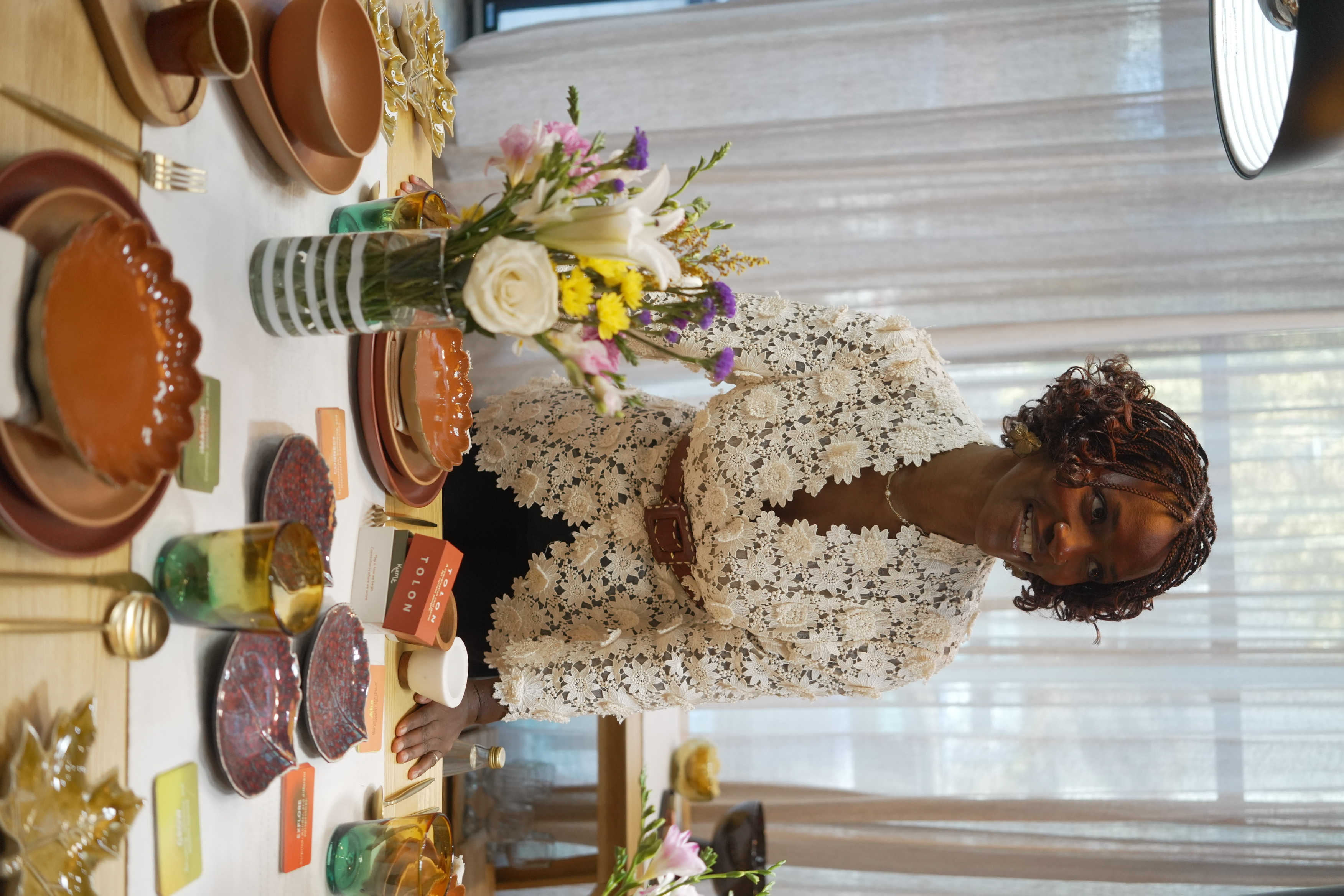
Yelka Kamara opens a box of cards. Dividers run through it like a Rolodex. “What did a Rolodex do for people?” she says. “It reminded you to call somebody.” The cards are Tolon, her new conversation game. Its name comes from a Mandeng word that evokes play, amusement, and shared moments. You draw one. You read the prompt out loud. You tell whatever story it brings up. Other cards let everyone else in. Nobody sits and waits for a turn.
“You’re not being a spectator,” she says. “You’re participating.”
Long before she created the game, that was how things worked in her childhood home. She was born in Sierra Leone. She came to New York around nine and grew up in Jackson Heights. She is the eldest, and the only girl, with three brothers. Her father, “Baba” was born into a Finah family. In Mandeng society, the Finah are oral poets, historians and storytellers. They carry culture forward and part of that responsibility is having the courage to speak.
“They say when something is difficult to say, call a Finah,” she says.
Baba came to the U.S. at about 16 and finished high school in Massachusetts. The family that cared for him, the Jacksons, became family too. Holidays were split between Queens and Massachusetts.
People were always coming over. For Kwanzaa. For her fifth-grade birthday, after a pool party at the Y. Someone would pick up an instrument. Then everyone did. Nobody was told not to touch. “There was always joy,” she says. “It was always participatory. I come from a household where storytelling was just what we did. I don’t think as a kid I really understood that.”
When her parents dropped her off at college, they introduced her to everyone in the building including the cleaning staff. Now, at weddings, her friends count on her to find whoever is sitting out and get them dancing. “I think that’s from just watching my parents model that,” she says.
For years, she wanted no part of the lineage. In college she was asked to be interviewed for a documentary about it. She didn’t want to. “I resisted it for so long,” she says.
At 26, a relationship ended. She went to therapy. One day her therapist let her finish talking, then asked what if she told herself a different story. “I remember just sitting there like, oh my god, it’s all about stories,” she says. “For some people, the end of a relationship is their villain origin story. Mine was my hero's origin story.”
She went back to journaling. The MyKume Journal grew out of that. Now she studies the lineage. “So much of being a Finah is about courage,” she says. “So much of my self-discovery journey has been about courage too. Being able to say the difficult things. Naming them.”
“I’m a Mandeng woman, I’m a Black woman, I’m an African woman,” she says. Her personal Instagram says Finahmusu. Her father’s father raised him to hold on to being a Finah, even in America. She hopes he’s smiling now.
Kume House started as a podcast, “Kume: Turning Point Diaries.” Now it is the MyKume Journal, workshops and Tolon. Her workshops, “Kume: Self-Talk Sessions” bring both together. They begin with movement, followed by guided journaling. Then people pair off and share what came up. Then the whole room comes back together. “It’s a brand about bringing people closer to themselves and closer to each other,” she says.
Growing up in Queens has let her see herself in so many different kinds of people. “I’m a Queens girl,” she says. “Through and through.” She moved to Astoria in 2013 with a friend from high school and she is intentional in her support of the community here.
Lockwood carries the journal. So does Incasa, and she’s collaborating with them on Tolon. Someone from the community connected her to Cafe 9, where she ran a journaling session in February. She is hosting a launch dinner for Tolon at Vesta on November 16. She already goes there with friends. “Whatever I’m doing, I’m thinking about who I have relationships with,” she says. “I’m not a spectator in my community. I’m an active participant”
She holds up a photo on her phone. She and her cousins as kids, in costume. A brother shaking an instrument. On weekends their parents left them with her grandmother in New York. The cousins made up dances, wrote programs, and performed when the parents came to pick them up.
Inside the journal there is a doodle by her late grandmother, Grandma Jackson, who always sent doodles and every doodle was told a story. “I believe that we are all storytellers,” she says.
Yelka Kamara is the founder of Kume House: www.kumehouse.com or @kume_house