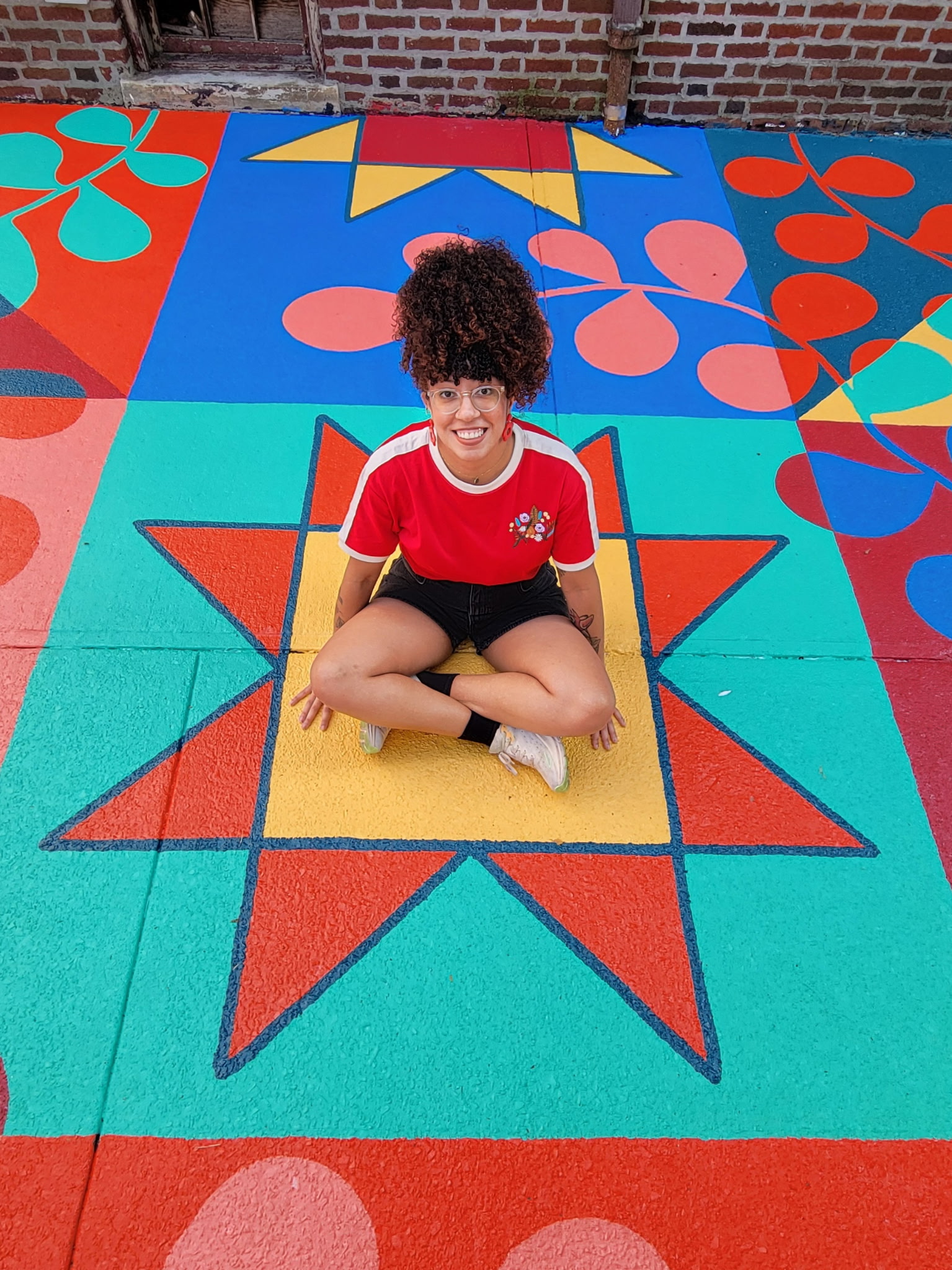
The first thing Talisa Almonte made for Astoria was 250 masks.
It was 2020, the neighborhood was locked down, and Talisa had just moved to Astoria from Jackson Heights the year before. She barely knew anyone. A sewing network needed hands. She showed up with her fashion industry background and started cutting fabric.
That is how she found this neighborhood. Not through a bar or a dinner party. Through utility. Through a woman who knew how to make something and a community that needed it made.
Talisa grew up in Miami, the daughter of a Dominican illustrator who could draw anything. Her father was an artist the way some people are just built, and Talisa watched him work her whole childhood. When she was in college, he had a brain aneurysm. He survived, but he never drew again.
She did not find out until later how much he had followed her career from a distance. Their final conversation before he passed in 2021 was about her art. He told her he was proud. He told her to keep going.
She had moved to New York years earlier to study fashion design at FIT, and the industry took her in. Four years at Victoria’s Secret Pink, then concept design at Gap. She was good at it. She was designing for scale, for systems, for brand. Then the pandemic hit and Gap eliminated the entire concept team. In the same season she lost that job, she lost her father.
From a place of reflection and healing, she built Almonte Studio.
The transition from fashion to independent art was not a clean break. It was a slow accumulation. Vending at the open street markets on 31st Ave. Designing the logo for Tiny Owl, then painting their first commercial mural. Getting selected for an asphalt mural through an open call, making mistakes with the sealant, learning how the process actually works. A Union Square mural project in 2024 where she painted alongside veteran artists and paid attention to everything they did.
Her fashion background did not disappear. It became a method. Surface design, scale, pattern, the way color moves across a large field. The work she makes now pulls from all of it, but it belongs fully to her.
Right now she is painting a piano and preparing to cover a street.
Sing for Hope places painted pianos in parks across New York City for their 25th anniversary project. Talisa applied the way she applies for most things: she followed their Instagram with notifications on and waited for the open call. She was selected. The theme she is working with is “Music Heals Us.” Across the panels, a half-flower half-figure admires a piano player. A figure in headphones listens. Sheet music from Juan Luis Guerra’s “El Farolito” wraps across the surface. She is also starting a new asphalt mural on 31st Ave, alongside other artists and community volunteers who show up to help paint the street.
Both projects are public by design. The piano will end up in a park somewhere in the city. The mural will be underfoot for everyone who walks that block. Talisa has been making work for Astoria’s streets and storefronts since she first started vending at the open street markets, and she has watched what happens when art lives where people actually are. She describes this neighborhood as a small town inside a big city. She means that people know each other here, that a community exists, that when you need something, there is usually someone who can help or who knows someone who can.
She notices that 85 percent of the vendors at the open street markets are women-owned businesses. She notices that the businesses she works with most closely are run largely by women. When asked whether she thinks women run Astoria, she does not hesitate. She says women just get things done differently.
There is a tension Talisa is trying to work through this year. She has spent years making work that is commercially legible, work that can be described in a brief and delivered on a timeline. She is good at that. But she is also trying to build a body of work that is not organized around what someone else needs from it. She is trying to figure out what it means to make something just because it needs to exist.
Her father was an artist who stopped drawing after his aneurysm. She saw what that cost him. But he passed on his superpower so she knows she cannot stop.
—-
Talisa Almonte is a muralist, illustrator, and visual artist based in Astoria. Her work can be found at almontestudio.com. Follow her on Instagram at @almontestudio.
Women of Astoria publishes monthly. Nominations via DM at @womenofastoria.