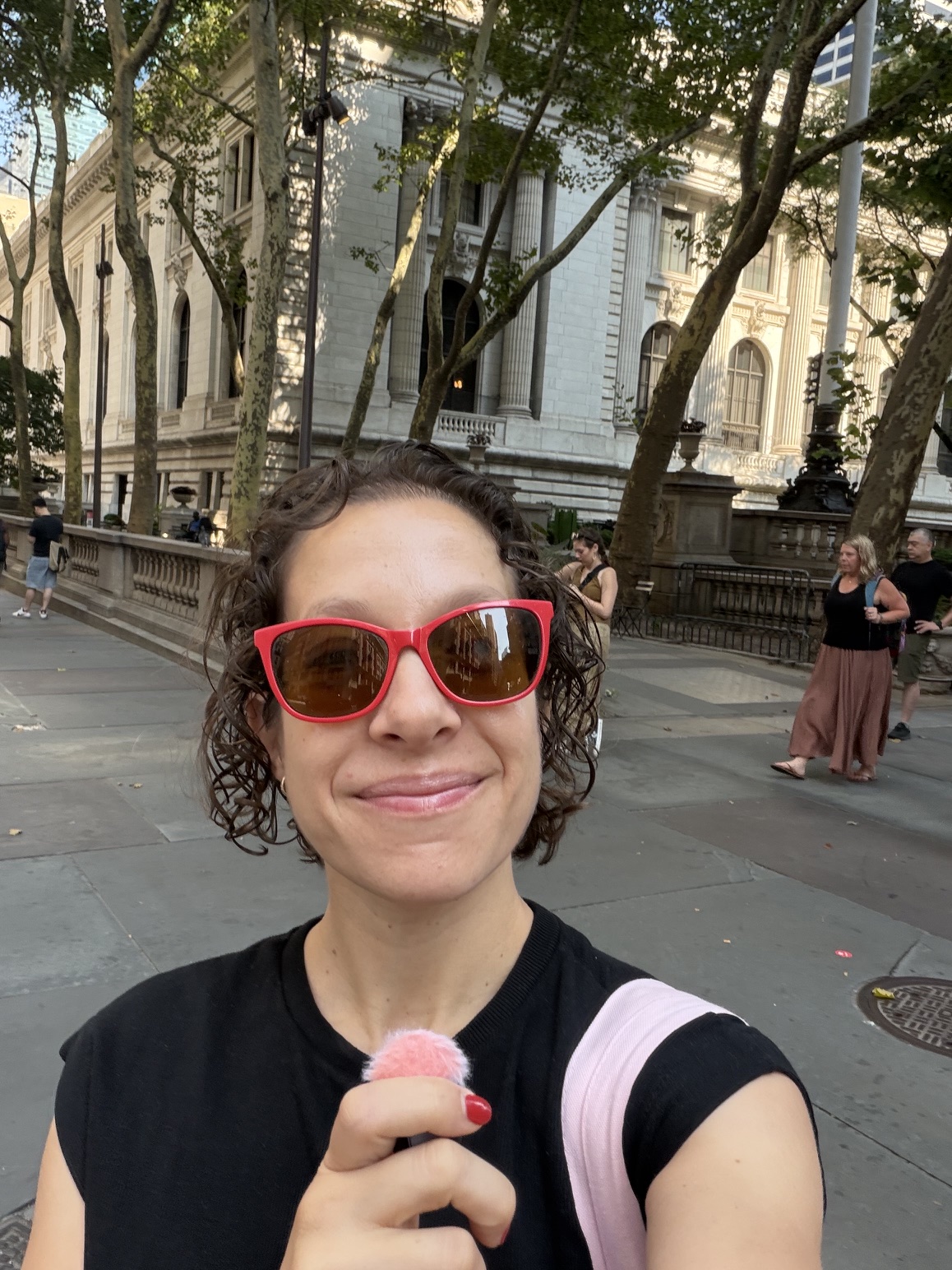
For years, Nikki Padilla Rivera told tourists about a woman who sold dumplings in Chinatown. The stop came early on the Lower East Side tour, the part that passes through Chinatown before moving on to Little Italy. She played the woman as the mean dumpling lady. She would tell the group not to make her mad. It worked. People laughed.
She never learned her name.
“That’s someone’s mom and grandma,” she says. “And I’m making her a joke.” She no longer uses that bit on her tours.
Padilla Rivera is co-owner of She Was Here, a women’s history walking tour company in New York. The tour runs a mile and a half over two hours. It has seven women on it. She wrote it, she trains the guides who give it, and she still gives it herself, with note cards, which she announces at the start.
The work is telling the stories of women who are not here to tell them. She thinks about the dumpling lady a lot and the responsibility that comes with this storytelling.
The tour began with a Google search. She typed in something close to unheard-of women in New York City and two books came back. She bought one, illustrated, thirty women sorted by category. Science, activism, theater. That was enough. One name led to another. She looked up who they worked with, what projects they joined, who was standing next to them.
“The information is not hard to find,” she says. “The work that goes into it is verifying everything. Getting multiple sources. Finding the story is not difficult.”
She is clear about what her research is not. She is not in the microfiche. She does not have time to be. She has a day job in brand marketing, two children, and a company she runs after they go to bed.
She cannot always remember the last names. She says so, unprompted. What she wants is for someone to go home and look a woman up.
To decide who makes the tour, she used her mother.
Her mother is a lifelong New Yorker, a retired public school teacher, a second-wave feminist who reads every historical novel set in the city. Nikki would bring her a name. If her mother had heard of the woman, the woman was out. Shirley Chisholm is the exception. She closes the tour. People know her, and they are glad to end there.
She built a spreadsheet and labeled every woman by race. She did it to make sure the tour was not all white, because the white women were easier to find, and because seven women cannot hold every history in New York.
“I had to cut based on race,” she says. “Which feels really weird to do.” Asked how she keeps it from being tokenism, she does not defend herself. “I feel like I do have to be intentional. To ensure that the diversity is there.”
Two gaps remain. She has no Muslim women’s stories, because the ones she finds are recent, and she looks for women whose impact has already been woven into history. She has no Native American women’s stories. She has written to organizations. Nobody has written back. She knows why, and she says it: some communities are rightfully protective because people ask them for things constantly. But people have offered to fill in the gaps including a rare books librarian, a wine journalist, the official Brooklyn historian.
On the tour, guests read the women’s own words aloud. That is how the words get spoken.
A woman was offered Frances Perkins and said she would read anyone else. She was from Evanston. She said her community had a history with Perkins.
The guide brought it back. Nikki looked it up. The labor protections Perkins built excluded agricultural and domestic workers, and the exclusion fell overwhelmingly on Black workers. Whether it was intentional is still argued.
She wrote it up and gave it as a tour note to every guide so they have that important context.The tour notes grow as new details and perspectives uncovered through the storytelling itself.
She went to a reading at Gloria Steinem’s house. Samantha Brown was on the couch. She shared that her ethical commitment is to not tell the story of someone who cannot tell it themselves.
But Nikki is left wondering about the women who were not able to tell their own stories. “Then they are not told” and she struggles with that.
She has settled on a smaller claim. She is not the authority. She is not the archive. She presents what she has, says out loud that it is all she has, and when someone in the comments tells her what she missed, she thanks them and adds it.
“I’m showing the gap.” The rest she hands over.
There is one woman she keeps returning to.
Audrey Munson modeled in the early 1900s. Her face is the gold figure on top of the Municipal Building. She is on the New York Public Library. She is at the Met. She was on the base of the Manhattan Bridge before they moved her to the Brooklyn Museum. She is on the Titanic Memorial.
Her landlord became obsessed with her and murdered his wife. Munson’s career ended. She tried to kill herself. Her mother committed her to a state hospital upstate, which is what was done then.
She was thirty-nine. She lived to a hundred and four. She was buried without a headstone.
An artist working across from one of her statues kept seeing the same face on buildings all over the city and went looking. That is how the name came back.
“She’s everywhere and forgotten,” Nikki says. “That’s the worst of it.” People take the tour now, and afterward they pass a municipal building and look up.
She was three when her family left Astoria. Her father took work in Delaware, then Connecticut. Her parents told everyone they were New Yorkers the whole time. Every summer, every holiday, they came back.
Her grandfather was a volunteer tour guide with Big Apple Greeters. He also sat with immigrants learning English, mostly women whose husbands had been sent here for two years, who knew nobody. Her grandparents became their family. She grew up in those rooms. Lunar New Year at somebody’s apartment. Korean barbecue. Other people’s ordinary lives.
He took her to museums, to shows, on the ferry, to neighborhoods she had never seen. She came back for college in 2006 and lived in his basement.
She became a tour guide to practice Italian before a semester abroad, volunteering with Big Apple Greeters, the same organization. She figured she would do it until she worked out what she wanted. It became a career.
She lives in Astoria. She has two kids. The fourth and fifth generation living in the family home. Wednesdays in summer, the Museum of the City of New York is open late and free, so she puts both children on the cargo bike, rides to the ferry, takes the bike aboard, and goes. Meanwhile her partner, José, does the laundry and cooks for the week. At the museum, her four-year-old found Mr. Tony from the Harlem Grown book on the wall in the activist New York room and recognized him.
At the Met she asks the kids what they want to see. A cat, they say. She finds a guard and asks if there is a cat painting anywhere. They go look at the cat. They get a drink at the museum cafe. That is the day.
She works a full day, picks the children up at four, and stays with them until bedtime. Then she opens the laptop and works until three in the morning.
People in her industry tell her it is amazing how much she can juggle in a day. She does not want to be that example.
“It actually shouldn’t be this hard,” she says.
Nikki Padilla Rivera co-owns and runs She Shapes History (soon-to-be She Was Here) in New York, and is a fourth generation Astorian. Her tours can be found womenshistorynyc.com or @sheshapeshistorynyc.
Women of Astoria publishes monthly. Nominations via DM at @womenofastoria.