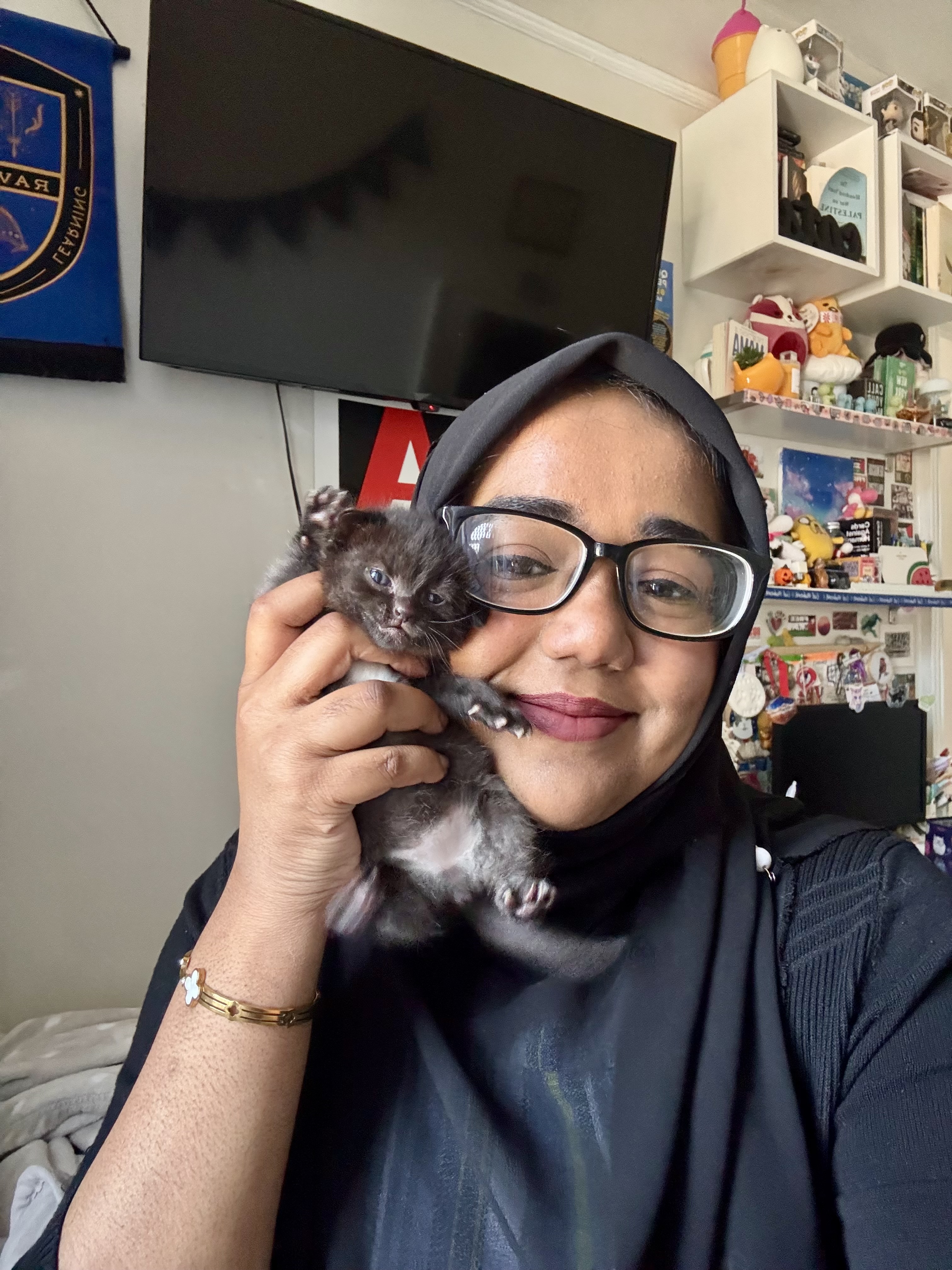
Jan met her first cat in second grade. Her name was Mimi, a playful little black kitten who belonged to a neighbor a few blocks away.
Jan grew up in Astoria. Her parents moved here from Bangladesh. The apartment she lives in is the same one her father moved into when he first came to New York in the 80s. The blocks where she traps cats are the blocks she has known her whole life.
During the pandemic she fostered two tabby kittens, her first rescues. Her mother was scared at first. Her father warmed up faster. When the first kitten was adopted, the family kept the second. Her brother named him Neko. He still lives with them, along with Forest, a black long-haired cat Jan adopted years and many foster kittens later.
Self-taught and TNR certified, Jan met Victoria and Monika in January 2023, the cofounders of LIC Feral Feeders. The group started in 2017 when a few neighbors in Hunters Point realized they were all feeding the same community cats. They pooled their efforts and became a 501(c)(3) in 2023, just before Jan joined. She saw a small, down-to-earth group doing serious work, and knew she had found her place.
Today she directs operations for LICFF. She runs the team's schedule at the ASPCA Queens Community Veterinary Clinic on 36th Avenue and 14th Street. It is the only ASPCA clinic of its kind in all of Queens. On clinic days, Jan is there at 8am with up to 25 cats. Checkout is at 4pm. She does this around a part-time job at the American Museum of Natural History.
There is a cat she thinks about whenever she walks past 30th Avenue and Crescent Street.
His name was Crescent Brownie. By the time a feeder spotted him, he was thin and sickly, walking slowly around the shelters in the area looking for a place to curl up in. Cats know when it is time. They look for a safe spot to hunker down. The feeder trapped him with Jan's help. The next day, blood work showed organ failure. The doctor said the kindest thing was humane euthanasia. Jan stayed with him through it. He was not the first cat she had sat through it for. He was the first local community cat, and she did it alone.
"I'm glad he didn't have to crawl up into that shelter," she says.
Right now is kitten season.
"It's more like a horror movie that keeps playing over and over again."
Spring and summer are the peak, but kittens come year-round. Most do not survive past six months on the street. Neonates need bottle feeding every two to three hours. There are never enough volunteers who can do that.
The math is not a mystery. New York City spends less than three dollars per capita on animal welfare. Miami spends thirteen. Dallas spends fourteen. There is no real municipal infrastructure for community cats. The work falls to independent rescuers and the small nonprofits they build around themselves.
The story Jan tells when she wants you to understand the upside is about a tuxedo kitten named Limpy. Limpy had rickets. Her rehab took six or seven months. Calcitriol drops to strengthen the bones, a strange diet that included rotisserie chicken, a medication schedule Jan kept on her own. By the time Limpy had been in foster care for months, Jan was losing hope. Which she says now is ironic, because the kitten's name is Hope.
Her adopter is an artist and performer named Nicole, who is outspoken about being autistic and works to make accessible spaces for other disabled performers. During the meet and greet, Limpy got overstimulated by a wand toy. Nicole stopped before Jan could say anything. "We're a little overstimulated right now. That's totally fine."
"She just got it immediately," Jan says.
They eventually traced Limpy's rickets to her diet, not her genes, which meant it could be solved. Now she climbs to the top of the cat tree. She is, in Jan's words, the chunkiest little six pound adult cat she has ever known.
"It's not a happy ending. Happy ending isn't the right word for adoption. It was her happy beginning. Her person found her."
Last year, an email came through the LICFF contact form. An abandoned house in Queens Village. Friendly cats left behind. One of them looked very pregnant. Can you help. LICFF does not usually go that far out, but they had the foster capacity, so Jan and her team went.
The house was a wreck. Outside, they trapped the father and older kittens from a previous litter. Inside, in the kitchen, the pregnant cat the email had mentioned was no longer pregnant. She had given birth on the living room floor. The broker had moved her into a cardboard box with a soft round bed inside. The bed was still stained with blood. Four kittens with their umbilical cords attached were nursing on her. They were less than a week old.
"It really did look like a look of relief," Jan says, when the mother turned and saw them walk in.
Her name became Tulip. The kittens became Petal, Leaf, Bud, and Blossom. The older siblings from outside, all friendly, became Zuko, Azula, Sokka, and Katara. All of them went into foster care across three different homes. A week or two later, an orphaned neonatal kitten named Clover, the first kitten Jan ever bottle fed, was placed in with Tulip's litter. Tulip took him in. The foster family ended up adopting Clover and his new sister Leaf. Foster failure, in rescue language. The good kind.
Jan wants to get an MBA and move into tech. The plan is not to leave the cats. The plan is to earn enough to keep funding the work, and to eventually open a community hub somewhere in the neighborhood. A small sanctuary, a supply pantry, workshops where neighbors learn to build winter shelters and care for the colony on their own block, adoption events that bring people in.
She is building toward it in pieces. Winter shelter workshops with Materials for the Arts. A free clinic day with Positive Tales. Monthly adoption events at Culture Lab LIC. Author events at Astoria Bookshop. Free programming at Queens Public Library.
The asks are simple and urgent. Foster homes for bottle-fed neonates. Foster homes for friendly adult cats who once knew the warmth of a home. Adoptive homes for overlooked adult cats, including Scar and Cinnamon, a bonded pair who have been waiting two years to be adopted together. Donations. Kitten food. Neighbors who will show up to a cleanup day, ask the super on their block what they have seen, learn how a colony works instead of stepping around it.
Earlier this year, Mimi passed. She had lived seventeen spoiled years in Astoria. During the pandemic she and Jan reentered each other's lives, and Jan spent the last few Christmas breaks looking after her while the family was away.
Mimi was the first cat.
Later today Jan will trap a sick cat near 36th Avenue. Tomorrow there are nineteen cats moving through the clinic. The horror movie keeps playing. She will be at the clinic at 8am.
—
Jannatul Ahmed directs operations at LIC Feral Feeders and is based in Astoria. LICFF can be found at licferalfeeders.org or @licferalfeeders. Follow Jan on Instagram at @janskittens.
Women of Astoria publishes monthly. Nominations via DM at @womenofastoria.