New York City public schools reopen September 10. For Anju J. Rupchandani, the weeks leading up are the heaviest lift. She spent the summer on site visits and licensing paperwork for a new after-school program, hiring staff, mapping the year's goals, and fundraising. The start of the summer means something narrower and more urgent: a list from each principal of the incoming students and the previous year’s attendance to determine whether they were chronically absent. The next step is a home visit to every kid who missed too much school last year, before the doors open.
Dr. Anju J. Rupchandani is the Executive Director of Zone 126. The organization fights chronic absenteeism in Astoria and Long Island City, in the public schools focusing on public housing students and the shelters in the surrounding areas. .
She works in the zone. She lives in the zone. She shops in the zone.
Here is how it starts. Any kid with more than twenty absences gets a home visit before school begins. She does the math and gets practical with families, and tells her team to do the same. Two days a month is twenty days a year. Twenty days is a month of school instruction gone. Miss the first two days, the Thursday and Friday after Labor Day, and a child is already considered chronically absent. Most parents do not know that.
The home visits turn up more than attendance. A family doubled up in one apartment. Not enough food. A kid sent out to work. A parent choosing between the rent and clean clothes. So the work is built around that. A family drops laundry off at the nearby laundromat and gets it back clean, sixty pounds a month, paid for by Hydro-Quebec (HQ), and Champlain Hudson Power Express (CHPE) . Staff bring a grocery tote from the pantry every time they knock on a family’s door.
Then they watch to see if the kid starts showing up.
Zone 126 started in 2011, out of a needs assessment of the neighborhood. Not enough kids in its public housing were finishing high school and going off to college and coming back . The founders, the Thomas & Jeanne Elmezzi Foundation, looked at the Harlem Children’s Zone and decided to replicate the work in Astoria & Long Island City. As Dr. R. says “it’s about going deep in one neighborhood instead of wide across a city.”
She points to the numbers. Attendance up eight points at one middle school, against a national average around three. Graduation at the local high school up from sixty percent toward eighty, two or three points a year. Incremental gains that are meaningful.
This is her neighborhood. She grew up one zip code over. Her mother brought them across the Triborough Bridge in the seventies and called Astoria the suburbs because of the trees.
Bronx born, Queens bred, she says. A pipeline kid. She went to the local schools, and she thinks telling a child to leave their neighborhood for another to go to school tells them something is wrong with where they live.
She started her career more than twenty-five years ago in youth development, tutoring third graders in her own elementary school. Fifteen years ago Zone 126 needed a community organizer and she returned back home to the community that raised her. She wanted to work specifically with the families in NYCHA housing and in shelters, she says, because they are the ones nobody follows up on, that seem to always be forgotten.
She met Claudia Coger in August of 2011. Coger ran the NYCHA Astoria Houses residents association. Anju had grown up closer to NYCHA Woodside Houses and had never been down to the Astoria Houses. She used the word everyone used. Coger stopped her. Do not call it ‘the projects,’ she said. No one is a project to be worked on.
Anju has led with that for fifteen years. The work was never about bringing programs to housing residents. It was about engaging them in the process, asking what they needed, and building from there.
She is exact about what she wants for the kids because no one was exact for her. She is the first in her family to graduate from college. She met the college counselor once in senior year. At seventeen she was signing loan papers for a gap a small scholarship did not cover, and she spent twenty years paying it back.
So getting a kid to college is not enough for her. Getting them through is not enough. They have to come out owing nothing. Nothing to the government, nothing to a bank. Debt free and into the middle class.
She comes from a long line of strong Caribbean women. Her mother left school in the fourth grade to raise a family. Her grandmother had nine children and could not read or write. Her great-grandmother sold fruit in the islands at a college, illiterate to the people who bought from her. Anju is mixed race with a last name that fits none of the boxes on a form. She checks ‘other,’ refusing to be put in any one box.
She has wanted to quit the work many times over the last few decades. The city loses the paperwork. The state money comes late. The funder rejection emails keep coming without feedback. What gets her back is going to a school and engaging with a young person. For her it’s the work itself.
There are two places in Astoria she loves. The base of the Triborough Bridge in the evening, when the lights come on, the same bridge she came over as a child. And the base of the 59th Street Bridge at Queens Plaza, where her mother would pick up unemployment checks. In a city of eight million, those are the places where the city goes quiet for her, where she can reflect, and where she often finds the will to keep going.
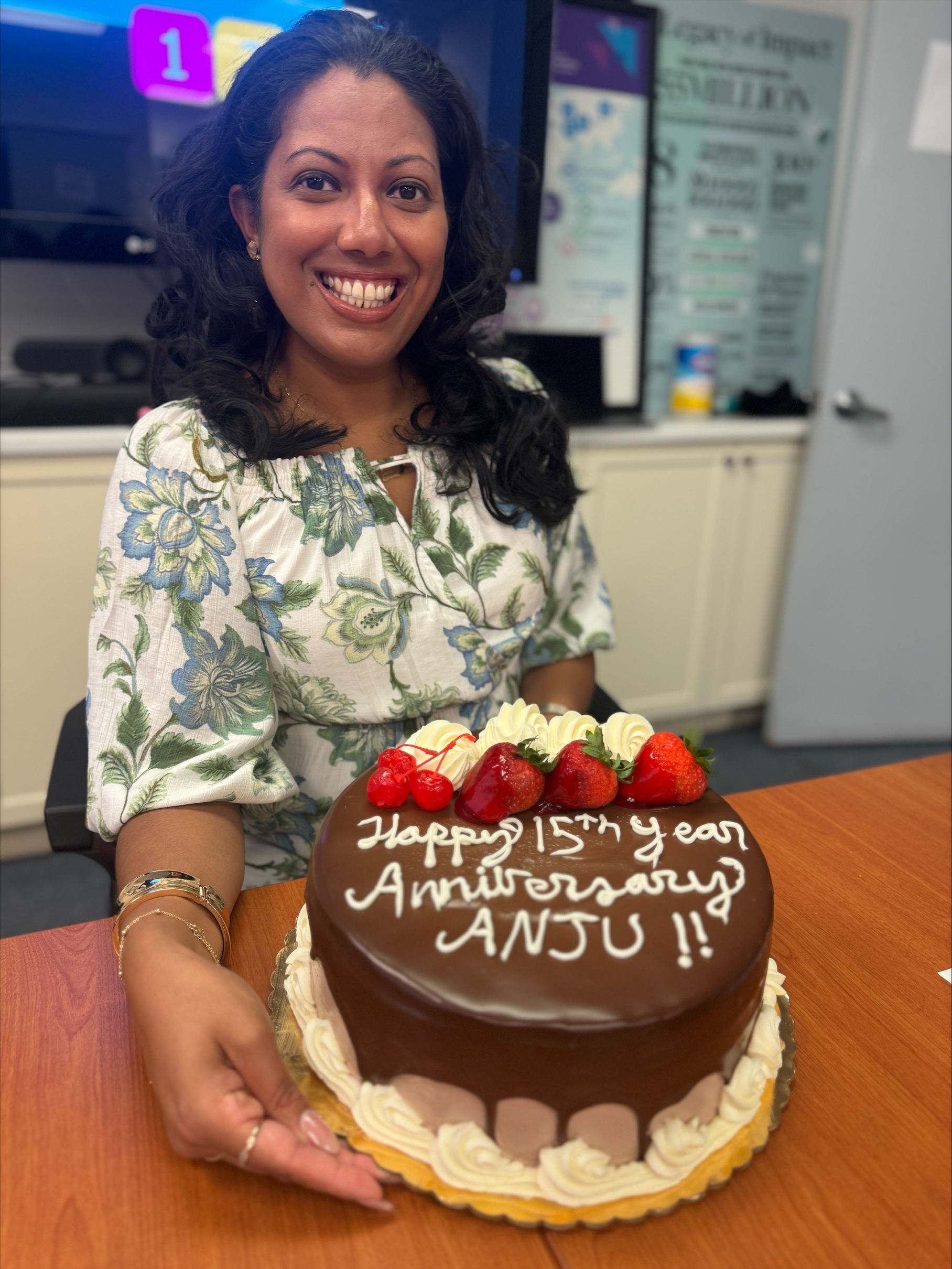
This year she marked fifteen years at Zone 126. She celebrated with a seven-layer cake from Martha's Country Bakery because it’s tradition, she says.
Her favorite saying is to live for your obituary, because you would want it to be great – a life with a clear intention, grounded in service.
Dr. Anju J. Rupchandani is the Executive Director of Zone 126: www.zone126.org or @Zone126Queens
Women of Astoria publishes monthly. Nominations via DM at @womenofastoria.